Why Curaeon asks your reason for opening a record
What the purpose-of-access question is for, when it appears and when it doesn't, and where your answer ends up — so the prompt stops being a surprise.
What the question is
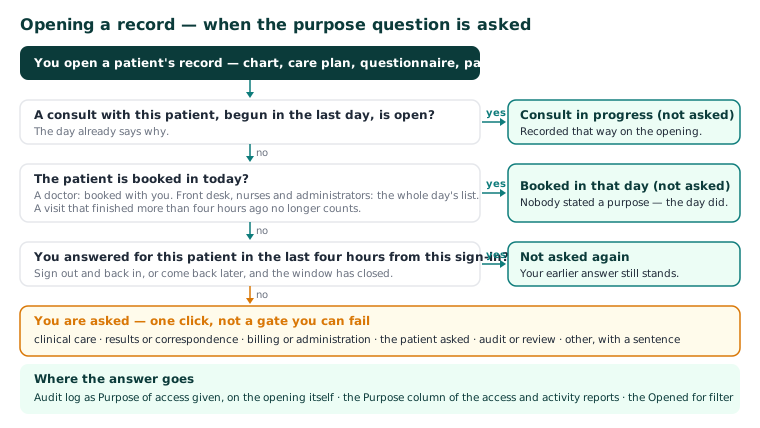
Opening a patient's record asks you first why: clinical care, results or correspondence, billing or administration, the patient asked, audit or review, or other with a sentence. It is asked on whichever page of the record you open first — the chart, a care plan, a questionnaire, a past visit's consult screen.
It is not a gate you can fail. It is a record of why, kept beside the record of that you did, so the practice can answer a patient who asks "who has seen my record, and why?" honestly (KB-063 — Answer "who has seen my record?": print a patient access report).
When it is not asked
You are not asked when the day already says why:
- you have a consult open with the patient that began in the last day; or
- the patient is booked in today. For a doctor that means booked in with you; the front desk, nurses and administrators work the whole day's list. A visit that finished more than four hours ago no longer counts.
Those openings are recorded as Consult in progress or Booked in that day, marked (not asked), because nobody stated a purpose — the day did.
How long an answer lasts
An answer stands for that patient for four hours from that sign-in. Open the same record again inside that window and you are not asked again; sign out and back in, or come back later, and you are.
Where the answer goes
- In the Audit log, as Purpose of access given, on the opening itself.
- In the Purpose column of the patient's access report and of a staff member's activity report.
- Administrators can narrow the log to one purpose with Opened for.
"No purpose given" — what it means
Some openings go ahead without a question being possible: a page printed, a result opened straight from the inbox, or a screen where the question could not be asked. Those rows say No purpose given. An integration's openings say Not asked (integration). Only openings from before the question existed show nothing at all.
The weekly Security review lists records opened with no purpose given, by staff member, with how many different patients and how many were answered Other (KB-064 — Sign off the weekly Security review, and act on alerts and audit-log check warnings). Nothing in that list accuses anyone. If you are choosing Other often, ask whether one of the named purposes fits.
Common questions
"I only looked at the appointment — why was I asked?" You weren't. Bookings, invoices and claims are not the clinical record; looking at a patient's invoices is recorded as Billing viewed, not as opening their record, and asks nothing.
"It asked me about a patient I saw this morning." The visit finished more than four hours ago, or the patient was booked with a colleague rather than you.
"Can it be turned off?" No — there is nothing to turn off. The question is how the practice's own record of access stays truthful, and the answer takes one click.
Related articles
- KB-063 — Answer "who has seen my record?": print a patient access report — Answer "who has seen my record?": print a patient access report
- KB-061 — Restrict a patient's record, and open one in an emergency — Restrict a patient's record, and open one in an emergency
- KB-064 — Sign off the weekly Security review, and act on alerts and audit-log check warnings — Sign off the weekly Security review, and act on alerts and audit-log check warnings