Lodge a feature request or a complaint, and what happens next
Both are tickets, both go through the same Raise a ticket form, and both are read by a person. There is no "type" to pick on the form — you tell us which it is in the first line. Here's how to lodge each so it lands with the right people, and what the reply on your ticket does and doesn't mean.
Before you start
- Neither needs anyone's approval — you raise it, it's in.
- If the thing you want to report is not working (rather than missing or disappointing), raise it as an issue instead: it gets a priority and a resolution target (KB-004 — Understanding ticket priorities and what to expect). A feature request or a complaint does not have a fix clock.
- As with every ticket, no patient details — describe the situation, not the person (KB-007 — Why we never need patient details in a support ticket).
The form
At support.curaeon.com.au, choose Raise a ticket. It asks for your practice name, your name and work email, what's the problem, in one line?, details, and has one checkbox — My clinic cannot see patients right now — which you leave unticked: it makes a ticket our top priority, and a request or a complaint is not an emergency. Start the one line with "Feature request:" or "Complaint:"; that first word is how it is sorted. As you type it, matching Knowledge Base articles appear underneath — worth a glance, in case what you want already exists.
Lodge a feature request
- One line:
Feature request: <the product area> — <what you want>— Records, Prescribing, Claiming, Bookings, Scribe or Portal. - In Details, describe the problem you're trying to solve, not only the button you'd like — "we lose ten minutes a day doing X by hand" is far more useful to the people deciding than "add a button for X". If a workaround exists, say what it costs you.
- Submit ticket. You get a reference on the spot; write it down.
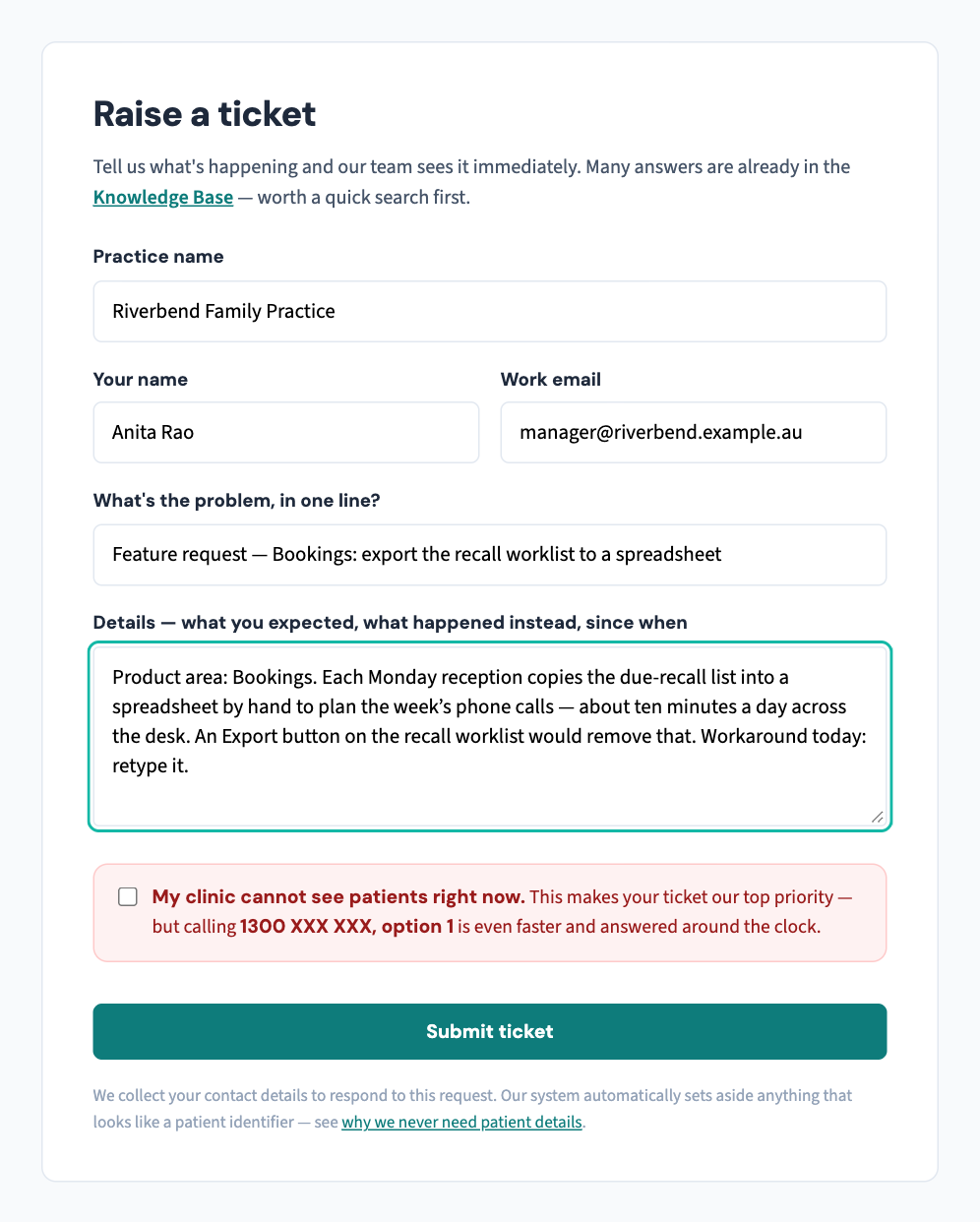
What happens next. Our team can see the ticket as soon as it is submitted, and the reply on it tells you who is looking at it. A reply confirms the request has been read and logged. It is not a commitment to build it, or a date — if you want to know where a request got to, ask on the ticket.
A few things you might expect to request are deliberate design, not gaps — the scribe never writes the Assessment, and Curaeon never suggests MBS item numbers (KB-056 — Why the scribe never writes the Assessment or suggests item numbers). We'll still log the request, and explain.
Lodge a complaint (or a compliment)
- One line:
Complaint: <what it is about>— how we handled something, or the software itself. A compliment goes the same way and gets read too. - If it's about a specific ticket, quote its number. Say what outcome would put it right.
- Submit ticket.
What happens next. A complaint is not answered by the agent it is about: the reply on your ticket names who has taken it on, and that person owns the response from there, through the same ticket.
If a complaint is about privacy or security
Don't lodge it as a complaint. Start the one line with "Security:" or "Privacy:" and say what happened — that is handled separately, and a suspected breach starts legal clocks the complaint route can't (KB-029 (internal), KB-065 — Assess a possible data breach: the 30-day NDB and 12-hour Services Australia clocks).
If that didn't work
Track a ticket on the site, with the reference and your email, shows where it is. If you have heard nothing, reply on the ticket saying so. We do not publish an acknowledgement clock for requests and complaints; if that matters to your practice, ask on the ticket and we will tell you what applies.
Still stuck? Raise a ticket at support.curaeon.com.au or call 1300 XXX XXX. If your clinic can't see patients right now, call and choose option 1. Support is staffed Monday to Friday, 8:00–18:00 Sydney time; outside those hours a call or text to the same number is answered on a best-effort basis.
Related articles
- KB-004 — Understanding ticket priorities and what to expect — Understanding ticket priorities and what to expect
- KB-016 — Reporting an AI scribe quality concern — Reporting an AI scribe quality concern
- KB-001 — Getting started with the Curaeon support portal — Getting started with the Curaeon support portal