Emailing patients FAQ
What the front desk needs to know about emailing a document to a patient — who can be emailed, the password, and what each refusal means — answered in place.
Who can I email a document to?
A patient who has consented to email and has an address on file. Both are on their record, under demographics with their preferred contact method. Everything sent is filed to the patient's record as outgoing correspondence.
"The patient has not consented to email"
No email consent is recorded. Ask the patient and record their answer on the record.
"No email address on file"
The record has no address. Add one.
"This patient is recorded as deceased"
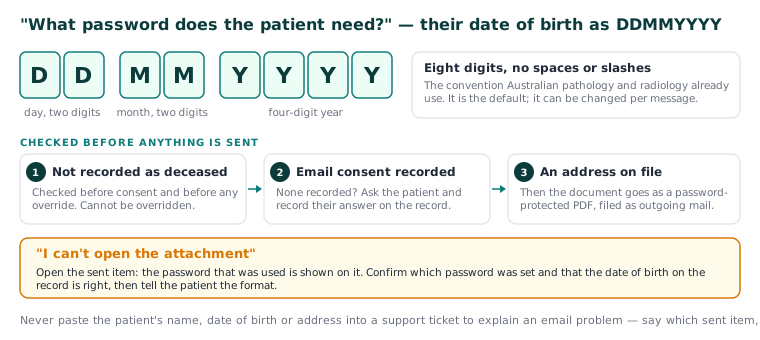
Correct, and deliberate. Recording a death or departure stops letters, recalls and reminders going to the patient, and this cannot be overridden — it is checked before consent and before any override (KB-041 — Find a departed patient, reactivate them, or record a death or departure).
What password does the patient need to open the attachment?
Attachments are password-protected PDFs. The default password is the patient's date of birth as DDMMYYYY — eight digits, day, month, four-digit year — the convention Australian pathology and radiology already use. It can be changed per message.
The patient says they cannot open the attachment
Open the sent item: the password that was used is shown on it. Confirm which password was set and that the date of birth on the record is right, then tell the patient the format (KB-050 — Email a letter to a patient: password, refused characters, "I can't open it").
"The mail server refused this address (…)"
The address is wrong, and the receiving server said so. The address is marked and stops being used until it is corrected. Correct it on the patient record; correcting it clears the mark automatically.
It was refused, naming a character it "cannot show"
The letter contains a character the PDF's fonts have no glyph for — most often a name with marks outside the Western European set. Retype that word, or compose the letter as a PDF and attach it. The letter is refused rather than sent with something silently missing, because a name dropped from a letter addressed to that person is worse than a refusal.
Emails send, but patients say they never arrive
Usually the practice domain's DNS. An administrator opens Settings → Patient messaging → Check DNS records and acts on what it reports. The same screen shows whether each channel — SMS, email, WhatsApp — can actually deliver, and names what is missing if it cannot (KB-060 — Patient emails or SMS reminders not arriving: check Settings → Patient messaging).
Will the emailed letter look like the letter on screen?
Yes. The PDF is set from the letter rather than approximating it — headings, typeface and size, the two flag colours, working links, and tables drawn as ruled grids. A letter of more than one page carries the patient's name and date of birth at the top of every page after the first, and "Page 2 of 3" at the foot, so a separated sheet can still be filed against the right person.
Can we change the message that goes with the letter?
Yes, in two ways. The person sending can change the message in the Send to patient box for that one patient. And the practice manager can write the message the box starts with, one for letters and one for referrals, under Message with a letter or referral in Settings → Patient messaging (KB-122 — Set up Settings → Patient messaging: email, SMS and WhatsApp channels, DKIM, the bounce mailbox and message wording).
Is there a record of what was sent?
Yes, in three places. The letter is filed to the patient's record; the chart shows Sent to patient and the letter's own send status; and the Audit log's Sent tab records what went, by email, to which address, and whether that address was typed at the time rather than the one on file. The weekly Security review counts documents sent out of the practice and lists first those sent to a typed address — worth a look, not a warning.
Important: Never paste a patient's name, date of birth or address into a support ticket, even to explain an email problem. Tell us which sent item and when (KB-007 — Why we never need patient details in a support ticket).
Still stuck? Raise a ticket at support.curaeon.com.au or call 1300 XXX XXX. If your clinic can't see patients right now, call and choose option 1. Support is staffed Monday to Friday, 8:00–18:00 Sydney time; outside those hours a call or text to the same number is answered on a best-effort basis.
Can I send a letter by WhatsApp instead of email?
Yes, once your practice has arranged WhatsApp with Meta (KB-140 — Arrange WhatsApp with Meta: the account, the number and the message templates Curaeon needs before it can send) and the patient has WhatsApp consent on their record. The patient receives your practice's approved message, with the letter attached as a password-protected PDF or a note that a letter is ready. What you type in the Subject and Message boxes is not sent on WhatsApp (KB-050 — Email a letter to a patient: password, refused characters, "I can't open it").
Related articles
- KB-050 — Email a letter to a patient: password, refused characters, "I can't open it" — Email a letter to a patient: password, refused characters, "I can't open it"
- KB-060 — Patient emails or SMS reminders not arriving: check Settings → Patient messaging — Patient emails or SMS reminders not arriving: check Settings → Patient messaging
- KB-088 — Letters and referrals FAQ — Letters and referrals FAQ