Recalls and reminders FAQ
The questions a front desk asks in its first month on the Recalls worklist — why a recall stays open, why one came back, and what to do with a reminder that never arrived.
Where do recalls come from?
A recall is raised from a result review, a care plan, the patient record, or with New recall on the worklist — search the patient, pick a program or type a reason, and set a date. The practice's standard recalls and their intervals live in Settings → Recall programs.
The patient has been seen, but the recall is still open. Why?
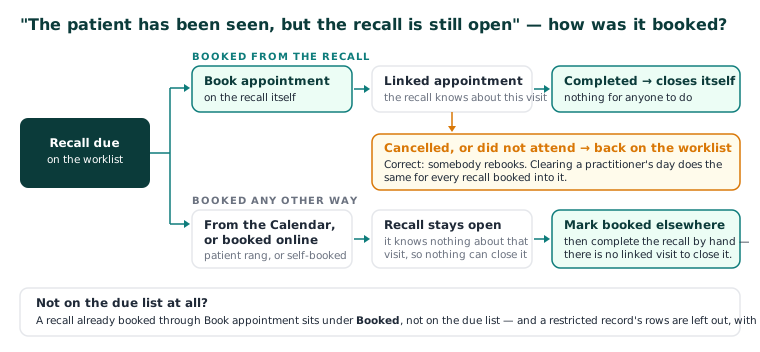
The appointment was not booked through the recall. A recall booked with Book appointment is linked to that appointment and closes itself when the visit is completed. If the patient rang and was booked from the Calendar, or booked online, the recall knows nothing about that visit. Use Mark booked elsewhere — and that recall then needs completing by hand, because there is no linked appointment to close it from (KB-051 — Run recalls: book from a recall, and why a recall stays open or comes back).
A recall I thought was done has reappeared on the worklist.
The linked appointment was cancelled or the patient did not attend. That is correct: the recall returns to the worklist so somebody rebooks. Clearing a practitioner's day does the same for every recall booked into it (KB-039 — Clear a practitioner's day when they call in sick).
Can we change what a recall reminder says?
Yes. Open Recalls → Message wording, write your own wording, and choose Use for Send reminder on it. From then on Send reminder on a recall sends that sentence, and a reminder run starts from it. Until you choose one, both send the built-in sentence. The steps are in KB-122 — Set up Settings → Patient messaging: email, SMS and WhatsApp channels, DKIM, the bounce mailbox and message wording.
Can we change what an INR reminder says?
Yes. Your practice manager can write the practice's own wording under INR reminder wording in Settings → Patient messaging (KB-122 — Set up Settings → Patient messaging: email, SMS and WhatsApp channels, DKIM, the bounce mailbox and message wording). It can say when the test is or was due, and can never include the result.
A patient is on Failed reminders. What do I do?
A reminder did not reach them. Correct the mobile number or the email address and retry, or ring them and mark it handled with a note. Reminders go by text, or by email where the practice has ticked it (KB-122 — Set up Settings → Patient messaging: email, SMS and WhatsApp channels, DKIM, the bounce mailbox and message wording) — if nothing is reaching anybody, check Settings → Messages to see whether texts are leaving the queue (KB-123 — Read the reminder queue in Settings → Messages, and know which messages screen you need) and the SMS channel in Settings → Patient messaging (KB-060 — Patient emails or SMS reminders not arriving: check Settings → Patient messaging).
Can Curaeon ring or email the patient for me?
It can email, not ring. Send reminder on the recall sends the practice's recall message by text, or by email where the practice has ticked email for recalls in Settings → Patient messaging and the patient has consented to email (KB-122 — Set up Settings → Patient messaging: email, SMS and WhatsApp channels, DKIM, the bounce mailbox and message wording). Where the practice sends recalls both ways, the patient's preferred contact method decides which they get. WhatsApp is possible too, once the practice has arranged it with Meta and for patients who have consented to it (KB-140 — Arrange WhatsApp with Meta: the account, the number and the message templates Curaeon needs before it can send). A phone call or a letter is made by a person and logged with Log contact, so the chase is still on the record.
The patient wants to be contacted a different way.
Open the recall. The panel shows their preferred channel and whether consent for it is recorded. Set on another channel changes the patient's standing preference on their record — not just for this recall — so choose it because the patient asked, not because it is quicker today.
How do I see what has already been sent?
Reminder history on the recall lists every SMS sent for it with its send state. On the worklist, each patient's preferred contact — SMS, phone call, email or letter — shows beside their name.
The patient has left the practice, or has died. Do I close their recalls?
No. Recording the death or departure on the patient record stops recalls, reminders and letters going to them, and this cannot be overridden. The audit log records who did it and how many bookings and recalls closed (KB-041 — Find a departed patient, reactivate them, or record a death or departure).
Important: Record the departure or death rather than closing recalls one by one. Closing them by hand leaves the reminders and letters untouched.
I know a patient is due, but they are not on the list.
Two things to check. Booked and Completed show the pipeline beyond the chase — a recall already booked through Book appointment sits under Booked, not on the due list. And if the patient's record is restricted and you are not named on it, the worklist leaves their rows out and says how many it left out (KB-061 — Restrict a patient's record, and open one in an emergency).
Still stuck? Raise a ticket at support.curaeon.com.au or call 1300 XXX XXX. If your clinic can't see patients right now, call and choose option 1. Support is staffed Monday to Friday, 8:00–18:00 Sydney time; outside those hours a call or text to the same number is answered on a best-effort basis.
Related articles
- KB-051 — Run recalls: book from a recall, and why a recall stays open or comes back — Run recalls: book from a recall, and why a recall stays open or comes back
- KB-060 — Patient emails or SMS reminders not arriving: check Settings → Patient messaging — Patient emails or SMS reminders not arriving: check Settings → Patient messaging
- KB-041 — Find a departed patient, reactivate them, or record a death or departure — Find a departed patient, reactivate them, or record a death or departure